Bounce rate has become a popular metric lately. SiteCatalyst 15 includes it as one of the default reports in the Site Overview dashboard, it's a hit with anyone working on SEO/SEM strategies, and Avinash himself called it the "sexiest web metric ever" (see links below).
I find myself explaining the finer details of the bounce rate metric quite often and would like to compile a concise post that helps people understand how to interpret the numbers a little better.
Bounce rate is the percentage of single-page visits
or visits in which the person left your site from the entrance (landing) page. Put another way, it represents the ratio of visits that ended on the same page that they started, without clicking or viewing anything else, divided by total visits.
For me, and for the type of traffic we see at our organization, bounce rate is much more meaningful when we look at traffic coming from a search engine or social site. This is traffic that has some level of curiosity and has come to your site, maybe for the first time ever, looking for something, expecting to find what they are in search of, or anticipating a certain level of goodness (maybe trusting the source that shared the link via social media, for example). Yet, once they have clicked the search result or socially shared link, they quickly realize that the page is not what they were looking for, did not meet their expectation, and did not fulfill their anticipation for goodness, and they hastily leave your site.
We see a certain level of bounce from direct traffic (bookmarked, URLs typed in by hand, etc.), particularly on our homepage, and I am prone to shrug it off. Why? Analysis has shown that much of this bouncy traffic may have our homepage as the default homepage for their browser. Traffic coming direct to your site is more likely familiar with what they will find and represent a different portion of the audience that is less significant in my opinion, when it comes to bounce rate at least. Not worthless traffic, and by no means should it be ignored. But it is less meaningful and actionable to chase the bounce rate associated to direct traffic.
The metric feels especially confusing at our organization where we have dozens of report suites, many of which are for subsections of the large corporate website. So it will appear that you have a bounce on your page when you are looking at your specific report suite, when really the visit crossed through multiple pages within the organization. This is ultimately a fragmentation problem that we have to deal with, and will be able to address with the ability to segment in SiteCatalyst 15. It can also be viewed using a global report suite to get a broader context of the visit.
When it comes down to it, bounce rate is a confusing but very actionable metric. Changes can and should be made on key landing pages to decrease the number. Landing page may be ranking for keywords that are misleading to the visitor. Social network campaigns might not be targeting the correct audience or are giving the audience misconceptions of what they will find. The page might not have any other calls to action, useful navigation, or overall relevance, and most of those things can be fixed.
In a data filled world with no shortage of numbers, metrics, charts, and reports, it's nice to have one that you can do something about, once you understand it.
Other helpful blogs on the subject of bounce rate:
Showing posts with label omniture. Show all posts
Showing posts with label omniture. Show all posts
Thursday, September 1, 2011

Wednesday, August 31, 2011
A SiteCatalyst 15 side affect - RIP s.prop
With the recent release of SiteCatalyst 15, life as a web analyst has suddenly become much more fun.
The new features have opened up a whole new world of possibilities. Specifically, the incredible insights that can be gleaned from segmentation have me creating segments in my dreams at night. Dashboards have become much more useful with the ability to get big picture overviews and then compare the differences between individual segments and the overall average traffic. Other features are incredibly helpful too, and the enjoyment of the day-to-day activities of analysis and reporting has only increased. Food even tastes better as a result, though I have no quantifiable way to attribute that back to our organization's upgrade to SiteCatalyst 15.
But in my mind, there is at least one casualty of SiteCatalyst 15: the s.prop. I'm not entirely saying that the s.prop is dead (well, I guess I did say that with the term RIP) nor has it completely lost its value. But I do believe it has significantly diminished in its effectiveness compared to the more powerful eVar.
Quickly reviewing the Omniture SiteCatalyst Implementation Manual reminds us that Custom Insight Variable (s.props) can provide us the following types of reports:
The new features have opened up a whole new world of possibilities. Specifically, the incredible insights that can be gleaned from segmentation have me creating segments in my dreams at night. Dashboards have become much more useful with the ability to get big picture overviews and then compare the differences between individual segments and the overall average traffic. Other features are incredibly helpful too, and the enjoyment of the day-to-day activities of analysis and reporting has only increased. Food even tastes better as a result, though I have no quantifiable way to attribute that back to our organization's upgrade to SiteCatalyst 15.
But in my mind, there is at least one casualty of SiteCatalyst 15: the s.prop. I'm not entirely saying that the s.prop is dead (well, I guess I did say that with the term RIP) nor has it completely lost its value. But I do believe it has significantly diminished in its effectiveness compared to the more powerful eVar.
Quickly reviewing the Omniture SiteCatalyst Implementation Manual reminds us that Custom Insight Variable (s.props) can provide us the following types of reports:
- Understanding user navigation through the web site
- Understanding internal user search behavior
- Segmenting traffic by navigation or category
- Segmenting visitor behavior by demographics
There's no denying the insight provided by a pathing report that you get with s.props that you can't get with the good ol' eVar. And having the ability to set up correlations is pretty helpful. But I have to set those up manually. And I only have twelve per report suite.
But with SiteCatalyst 15, I get full subrelations for all my conversion reports. For free. By default. No manual configuration. No limit per report suite. Just plain and sweet, for all my eVar reports.
And ultimately, I care more about conversion data than I do about traffic numbers. While it's nice to know how many times a value was populated into a s.prop, I can get a similar count using an eVar, and then I can break that down by my other reports.
So, agree or disagree? Has the s.prop lost some of it's value when compared to the eVar, with its wonderful full subrelations available in SiteCatalyst 15? What am I missing?
Thursday, August 18, 2011
Quick Look: Comparing GA and Omniture numbers
There is a constant battle in the web analytics world about tools. Some are free, others are expensive. Some will argue that one particular product is very simple while alternatives are too complicated. Another point of debate is the accuracy of one tool vs. another, and understanding why the discrepancy exists. It's really no different than any other industry. I remember the exact same debate as a developer arguing over which IDE was the best for writing code.
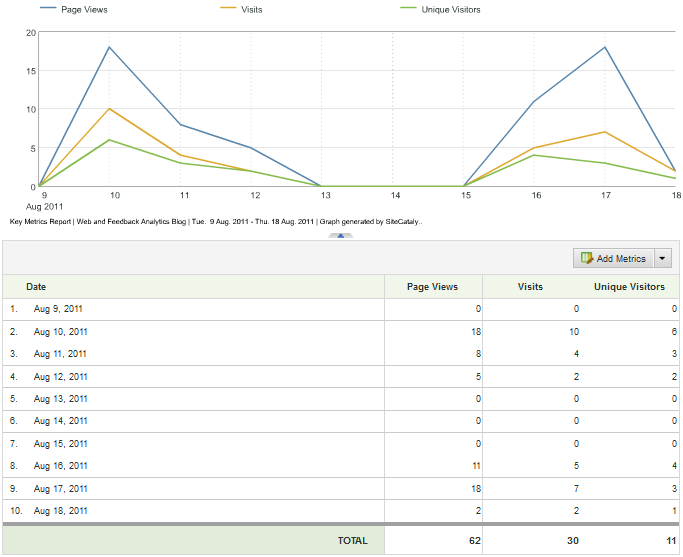
Surprisingly, the numbers are almost identical. This might be a side effect of such a small sample size (I'm not delusional about the popularity of my little blog). When we run this test again in 6 months, would we expect a bigger difference? Are there other metrics that would be worth comparing?
| Analytics Tool | Page Views | Visits | Unique Visitors | Bounce Rate |
| Omniture SiteCatalyst | 62 | 30 | 11 | 50% |
| Google Analytics | 61 | 30 | 10 | 53% |
A few other thoughts:
- Geo Segmentation showed the exact same countries represented.
- Average Time Spent on Site was much higher in SiteCatalyst
- Both show one visit from an iPhone
- The Visitor Loyalty/Visit Number Report was pretty similar in both

So, let's try this again in a few months and see what differences start to emerge.
Wednesday, August 10, 2011
Web and Feedback Analytics Intro
I spend a lot of time lately meeting with project teams, administrative staff, product managers, project managers and everyone in between. We talk about the whole gamut of web and feedback analytics, the data, the reports, interpreting the data and reports, the implementation in code, configuration of our tools, and on and on. So, the natural next step was to start a blog to capture many of those great conversations and provide a repository of resources about the subject.
I'm hoping to include a variety of things in this blog:
I'm hoping to include a variety of things in this blog:
- code snippets
- implementation best practices
- analytics theory
- using customer feedback
- actionable insights
- use cases
- links to other helpful blogs and articles
- real world stories
- statistics talk
- and who knows what else
I will focus most of my attention on Omniture with some Google Analytics. I will need to be discreet about specific websites in many cases but hope to share plenty of helpful tidbits and insights that were a benefit to me.
Subscribe to:
Posts (Atom)
